Automation teams / n8n workflow
Move n8n workflows without rebuilding every connection.
Workflow Importer
- n8n
- n8n Forms
- n8n API
- JSON
Problem
Moving an n8n workflow between instances is tedious and error-prone. Credentials don’t carry over, so every imported workflow arrives with broken connections, and people have to rebuild or re-link each one by hand.
Built
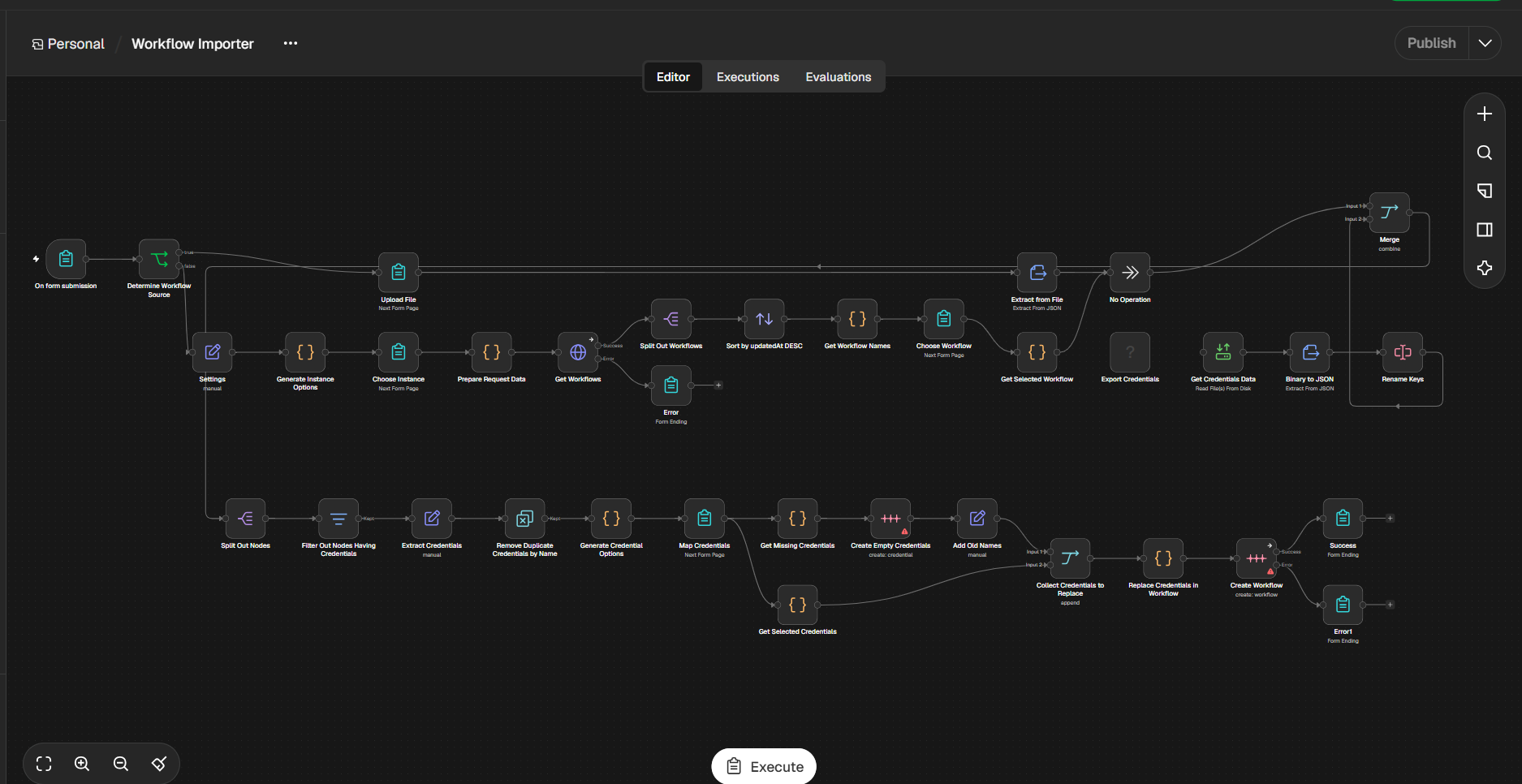
An n8n workflow that runs from a form: you choose a workflow from a connected instance or upload a JSON file, and it maps the credentials the workflow uses, creates any that are missing as empty placeholders, swaps them into the workflow, and creates the workflow on the target instance.
Result placeholder
40 min saved per workflow migration
User-supplied time-saving figure — not independently verified. Confirm migration timings before presenting this as a measured outcome.
The workflow, step by step
- 1
A form starts the process. The user submits an n8n form and picks where the workflow comes from: an existing instance or an uploaded file.
- 2
Instance details are collected. For the instance option, the user selects the instance and the request data is prepared.
- 3
Workflows are fetched. n8n calls the instance API, splits out the workflows, sorts them by most recently updated, and lists their names. If the call fails, the form ends with an error message.
- 4
The user picks a workflow. The chosen workflow is retrieved. With the upload option, the JSON file is extracted instead.
- 5
Credentials are exported. Credential data is read from disk, converted to JSON, and its keys are renamed so it can be matched against the workflow.
- 6
Nodes are scanned for credentials. The workflow’s nodes are split out, nodes without credentials are filtered away, and credential details are extracted. Duplicates are removed by name.
- 7
The user maps credentials. A form page lists the credentials found, and the user maps each one to a credential on the target instance.
- 8
Missing credentials are created. Any credential that doesn’t exist yet is created as an empty placeholder, so the workflow can be linked without exposing secrets.
- 9
Credentials are replaced in the workflow. The old names are recorded, the mapped credentials are collected, and the workflow JSON is updated to point to the new ones.
- 10
The workflow is created. n8n creates it on the target instance and shows a success page, or an error page if creation fails.
Human checkpoint
The user chooses the source workflow and confirms every credential mapping on a form before anything is created. Secrets are never copied, only empty placeholders, so credentials are filled in by a person.